Sorry for the delay, recently upgraded the computer and didn't have access to the wonderful world of ChemDraw. This post will be about the first meeting, and a second will come later this week on last weeks meeting.
This past Thursday fulfilled its promise of group problems. The majority of them, however, were something you would see in Sophomore Organic Chemistry. Sure, they were some upper end stuff, but Sophomoric none-the-less. It did provide an opportunity to council younger students on the dangers of saying "never".
The two problems shown here each have an abnormal leaving group. The first scheme can be written a number of different ways, but it is generally agreed that the final step is the displacement of a hydroxide group. Normally, you would never see it, but in basic enough conditions you can work some magic.
The second reaction (presented here to work out on your own) shows a methyl as the leaving group, again, a big no-no. Yet, through the magic of Iodoform (hint-hint) reactions, it can pop right off. Have fun!
-Woodward
Showing posts with label group meeting. Show all posts
Monday, September 23, 2013
Thursday, September 5, 2013
Notes from Group Meeting - 2
School year officially started this week, meaning we finally have group meetings again. A couple of people were mentioned jokingly between professors that I had to look up, cause I sure don't want to be left out of the loop.
The first person was Phil Baran. We were discussing a synthesis, and the presenter showed how a group achieved their goal by performing six steps to protect, oxidize, deprotect, an so on. Professor B said to Professor A (paraphrase), "With that many steps just for protection, Phil Baran must be in pain!"
Google tells me Phil S. Baran is a professor at Scripps, and his focus is on "Aiming for the Ideal Synthesis". His mantra: "Total synthesis in this century must therefore be keenly aware of this ultimate challenge – to be able to provide large quantities of complex natural products with a minimum amount of labor and material expenses." He follows JB Hendrickson's dictum, …creates a complex molecule… in a sequence of only construction reactions involving no intermediary refunctionalizations, and leading directly to the target, not only its skeleton but also its correctly placed functionality." He recently published in Science about a 14 step efficient synthesis that his group performed. He is well respected in his field. Many of his papers are protecting group free, and would be considered 'elegant'. Hence, the joke from Prof B to A.
The second person, I didn't actually get his name down, or exactly what happened. We were taking about ethics with all of the apparent fraud going on, and Prof A mentions Jim/John/Joe McNair/McClair/McBear and how he faked his NMR spectra for cylcohexanol (?). This was the big deal in the 90's, or so I'm told, long before I was ever in the industry. I wish I could find more on him, but the internet gods are not with me today. If you know more or can find something interesting about this, contact me and I will put more about him in. Anyway, that's all from group meeting this week. Next week there are practice problems, so I'll see if I can dig up anything fun/interesting/juicy about them.
-Woodward
Edit - Chris Vonnegut and Joshua Sacher (@ArgyleAardvark) have found who I was talking about. James LaClair was the man who published a synthesis of Hexacylcinol, in 2006. Check out the blurb on Wikipedia.
The first person was Phil Baran. We were discussing a synthesis, and the presenter showed how a group achieved their goal by performing six steps to protect, oxidize, deprotect, an so on. Professor B said to Professor A (paraphrase), "With that many steps just for protection, Phil Baran must be in pain!"
Google tells me Phil S. Baran is a professor at Scripps, and his focus is on "Aiming for the Ideal Synthesis". His mantra: "Total synthesis in this century must therefore be keenly aware of this ultimate challenge – to be able to provide large quantities of complex natural products with a minimum amount of labor and material expenses." He follows JB Hendrickson's dictum, …creates a complex molecule… in a sequence of only construction reactions involving no intermediary refunctionalizations, and leading directly to the target, not only its skeleton but also its correctly placed functionality." He recently published in Science about a 14 step efficient synthesis that his group performed. He is well respected in his field. Many of his papers are protecting group free, and would be considered 'elegant'. Hence, the joke from Prof B to A.
The second person, I didn't actually get his name down, or exactly what happened. We were taking about ethics with all of the apparent fraud going on, and Prof A mentions Jim/John/Joe McNair/McClair/McBear and how he faked his NMR spectra for cylcohexanol (?). This was the big deal in the 90's, or so I'm told, long before I was ever in the industry. I wish I could find more on him, but the internet gods are not with me today. If you know more or can find something interesting about this, contact me and I will put more about him in. Anyway, that's all from group meeting this week. Next week there are practice problems, so I'll see if I can dig up anything fun/interesting/juicy about them.
-Woodward
Edit - Chris Vonnegut and Joshua Sacher (@ArgyleAardvark) have found who I was talking about. James LaClair was the man who published a synthesis of Hexacylcinol, in 2006. Check out the blurb on Wikipedia.
Thursday, August 8, 2013
Notes From Group Meeting - 1
Today was our group meeting, and since it is also the end of the summer semester, the last one until Fall semester starts. So no more of these for a couple of weeks. That being said, there were a few things I learned today that I thought worth sharing.
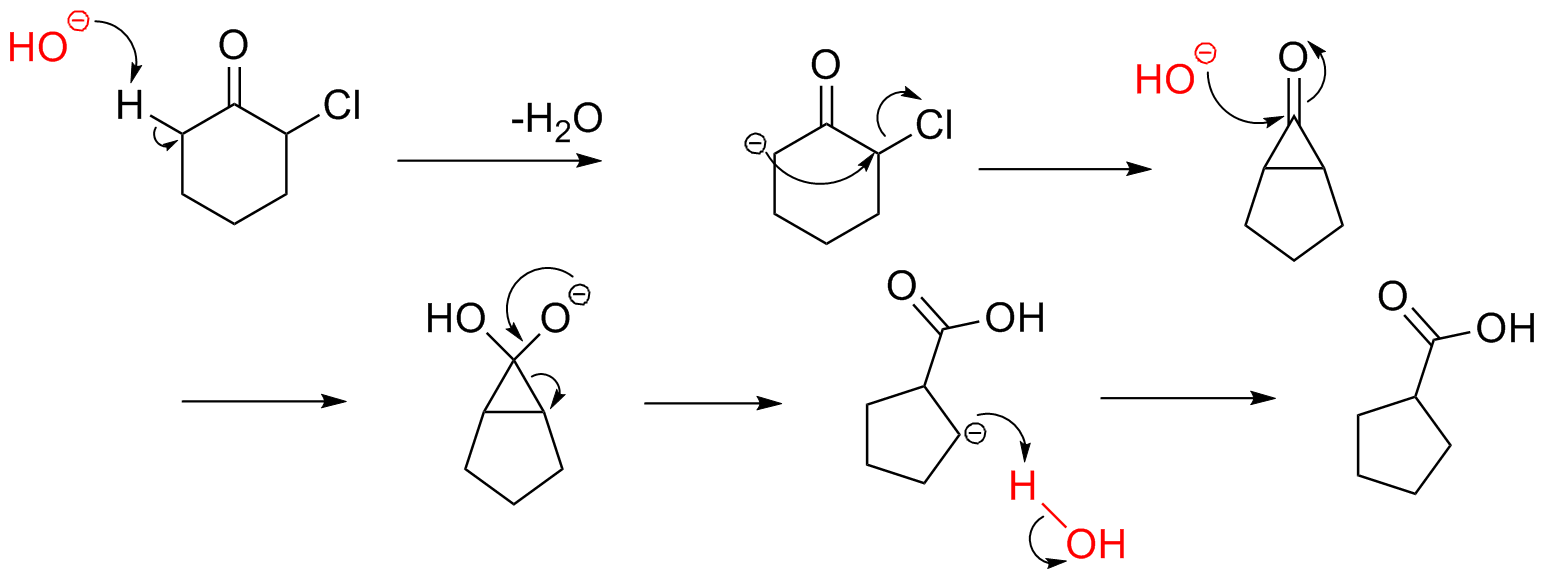
First up is from one of our problem sets. One professor, having not seen the problem before, said, "Ah yes, a Favorskii rearrangement!" I, of course, had never heard of it. Turns out it was more complex than I expected and thought you ought to know about it.
Alexey Yevgrafovich Favorsky was a Russian chemist back at the turn of the century (the 19th to 20th turn, not the most recent one). He was an accomplished scientist, and besides this rearrangement and one other reaction, his most notable achievement was receiving the Stalin award for improving synthetic rubber.
The Favorskii rearrangement is most commonly used to constrict ring, generally from a six member ring to a five member one. The general mechanism is as follows:
First up is from one of our problem sets. One professor, having not seen the problem before, said, "Ah yes, a Favorskii rearrangement!" I, of course, had never heard of it. Turns out it was more complex than I expected and thought you ought to know about it.
Alexey Yevgrafovich Favorsky was a Russian chemist back at the turn of the century (the 19th to 20th turn, not the most recent one). He was an accomplished scientist, and besides this rearrangement and one other reaction, his most notable achievement was receiving the Stalin award for improving synthetic rubber.
The Favorskii rearrangement is most commonly used to constrict ring, generally from a six member ring to a five member one. The general mechanism is as follows:
With that in mind, can you figure this out? Click the picture for the answer.
Edit: Spelled "Favorskii" wrong
Subscribe to:
Posts (Atom)